Material Development
Maharam vs. Private Label Fabric Sourcing: A Cost Controller's Honest Breakdown
-
The Comparison Framework: Brand Authority vs. Direct Sourcing
-
Color Consistency: Delta E and the Dye Lot Problem
-
Bedding Fabric Private Label: Customization vs. Spec Risk
-
Chenille Fabric Sourcing: Where the Hidden Fees Live
-
Maharam Rugs vs. Direct Rug Sourcing
-
Outdoor Fabric Distributor Buying Guide
-
Total Cost: The Bottom Line
I manage purchasing for a 40-person contract furniture dealership. Our fabric budget runs about $400k a year, and I've negotiated with 80+ vendors over the last 6 years. If you're deciding between specifying Maharam and going the private-label or distributor route for bedding fabric, chenille, or outdoor textile, this comparison is for you.
The March 2023 vendor failure kind of rewired how I think about procurement. A big chenille order came back with a 9% shrinkage claim rejected—the mill said we didn't specify finishing tolerances. That $3,000 order turned into a $1,200 redo, and I lost a week. Since then, I've become more interested in total cost than unit price.
Here's what you need to know before comparing: there's no universal winner. There are projects where Maharam is the obvious call, and there are projects where private label makes sense. The trick is knowing which one you're actually buying.
The Comparison Framework: Brand Authority vs. Direct Sourcing
The comparison is really between two buying paths:
- Specifying Maharam for upholstery, Maharam rugs, curtains, and outdoor fabric—getting a branded, specification-grade product with design authority and documented performance.
- Private-label or distributor sourcing—buying bedding fabric, chenille yardage, or outdoor rolls from a mill or an intermediary and managing the specs yourself.
That distinction matters. 'Private label' isn't a dirty word. It's a different value proposition. But it puts more work on your team, and that work has a cost.
To be fair, I've worked with some sharp private-label suppliers who provide great test data and stable dye lots. The best ones are genuinely comparable. The difference is that Maharam's process is more predictable, and their documentation is standardized. For a B2B buyer, predictability is worth a line item.
Color Consistency: Delta E and the Dye Lot Problem
Most buyers focus on price per yard and completely miss dye lot variation. It's the classic blind spot. The question everyone asks is 'can you match this?' The question they should ask is 'how do you handle dye lot variation on reorders?'
Industry standard color tolerance is Delta E under 2 for brand-critical colors. A Delta E of 2-4 is noticeable to trained observers; above 4, it's visible to most people. Pantone publishes this in their color matching guidelines.
In Q2 2024, when we compared a Maharam chenille against a direct-mill alternative at half the price, the direct mill's first strike-off came in at Delta E 4.5. On its own, the color looked fine. Next to the approved sample, it was obvious. We asked for a second strike-off. It came back better, but the two-week delay pushed our install schedule.
Maharam's dye lot controls are about as tight as you'll find in contract textiles. That said, I've had Maharam lots that weren't perfect either. The difference is their customer service immediately flagged the lot number and offered a replacement without a fight. With the direct mill, I had to argue.
So glad I double-checked the lot numbers before approving that order. I was one click away from approving a full run against an outdated spec (mental note: always confirm the current spec with the factory before PO).
Bedding Fabric Private Label: Customization vs. Spec Risk
If you're exploring bedding fabric private label, the math is different. Private label gives you customization—your own patterns, your own fiber blend, your own packaging. That can be a game-changer for a hospitality brand that wants a unique sleep experience.
But there's a trade-off. A private label bedding fabric program can cut material cost by 20-30% in my experience (ballpark, not a promise). At the same time, your team has to write the specs, manage the QA, and handle claims. When I audited our 2023 spending, I found that 18% of our 'budget overruns' on private-label orders came from spec changes after sampling. That's money you don't see until the invoice arrives.
Maharam's contract fabrics are not cheap. For a 200-room hotel, the difference can be five figures. But you're paying for their performance testing and liability, not just the label. If your clients judge you on the finished room—and they do—the perceived quality of the bedding affects their feedback. In one project, when we switched from budget to premium bedding fabric, client feedback scores improved by 23%. The $50 per room difference translated to noticeably better retention.
I get why private label looks like the smart move. Budgets are real. But if you don't have someone on staff who knows textile specs, the hidden costs stack up fast.
Chenille Fabric Sourcing: Where the Hidden Fees Live
Chenille fabric sourcing is one of those categories where the lowest quote can actually be the most expensive. Chenille has specific issues: pile twist, shrinkage, and abrasion. If the mill hasn't tested for these, you're the one who discovers the problem.
When comparing quotes for a $4,200 annual contract a few years ago, one supplier quoted $3.20 a square foot. Another quoted $2.70. I almost went with the lower quote until I calculated total cost: it added a $200 setup fee, $180 freight, and a 'color approval' charge of $70 per SKU. That brought the total to about $3.85 a square foot—not the cheap option. That's a 20% difference hidden in fine print.
The 'free setup' offer from another supplier actually cost us $450 more in hidden fees once we accounted for their mandatory fabric inspection and sample reorder charges. I built a cost calculator after getting burned on hidden fees twice. It's now part of our procurement policy: quotes from 3 vendors minimum, and every quote must list total landed cost, not just unit price.
For chenille specifically, ask for abrasion test results (Wyzenbeek or Martindale) and shrinkage data. If a supplier can't provide them, that's a red flag. Maharam provides spec sheets for every chenille SKU. Direct mills often provide them too, but only if you ask—and the answer determines whether you should even be on the same page.
Maharam Rugs vs. Direct Rug Sourcing
People think Maharam rugs cost more because of the brand name. Actually, it's kind of the reverse. The brand is a proxy for testing, tolerances, and liability. They can charge more because they deliver consistency, not the other way around.
Take pattern repeat. For a model suite, we bought a Maharam rug and a direct-import rug side by side. The Maharam rug had a pattern repeat accurate to within a quarter-inch. The direct import had a 3% skew on one end. On a 9x12 rug, that's nearly 4 inches of drift. The installer had to cut around it, and the pattern didn't line up at the seam. That's a $400 fix on a rug that seemed like a steal.
For large residential or hospitality projects, Maharam rugs are usually the safer choice when the design is pattern-forward. If you're doing a solid-color rug under a bed, direct sourcing might work fine. The visual margin for error is much bigger.
That said, if you're using a reliable rug distributor with good quality control, you can save a lot. Just budget for inspection time and a return allowance. In our cost tracking system, 11% of direct imported rugs had some defect—loose weave, wrong selvedge, or skew. Maharam's return rate on rugs in our portfolio was under 2%.
Outdoor Fabric Distributor Buying Guide
Outdoor fabric is where the spread between 'contract-grade' and 'residential-grade' claims gets wide. That's why this part of the buying guide matters.
When you're buying outdoor fabric from a distributor, don't trust the marketing line. Ask for test reports for every lot, not just the line's brochure. Specifically:
- Abrasion: Wyzenbeek or Martindale cycles (ask for the actual number, not 'commercial grade').
- UV resistance: ASTM G154 or similar, with hours and color change rating.
- Mildew and water resistance: confirm the fabric is treated, not just finished in a water-resistant way.
- Dye lot reserve: if you might need reorders, confirm the distributor can reserve a dye lot for your project.
Maharam's outdoor line comes with this documentation as standard. A good distributor can also provide it, but you have to ask. And if they hesitate, that's a deal-breaker for me.
One more thing: sample before committing to a full roll. A 6-inch swatch tells you color; a 30-inch sample tells you hand, drape, and how it stitches. For outdoor furniture, the last thing you want is a fabric that looks great in the sample book but doesn't wrap around a chair frame.
Total Cost: The Bottom Line
Let's put it in numbers. In 2024, we ran a comparison on a typical hospitality package (based on our quotes at the time; verify current pricing): 300 yards of upholstery, 120 yards of chenille, 240 yards of outdoor fabric, and six area rugs.
- Full Maharam spec: $42,800, including freight.
- Private label / distributor alternative: $31,600, but after inspection, color approvals, and one reorder, it was $36,900.
That's a $5,900 difference—not nothing. But it's less than the $11,200 'savings' the private label route seemed to offer. And if the client is design-sensitive, the risk of a mismatch goes up.
To put it bluntly: I'd rather pay Maharam's price and sleep through the install than save money and worry about whether the trim will match the drape.
When to specify Maharam:
- Client-facing, design-driven projects where brand and finish matter.
- Pattern-forward upholstery, Maharam rugs, or any project with large visible seams.
- Projects requiring spec-grade documentation and color consistency across multiple rooms.
When to go private label or direct:
- Back-of-house or interior-only spaces where budget is the main driver.
- High-volume bedding programs where you need custom branding and your team can manage specs.
- Projects with a trusted distributor who can provide test data and local stock.
At the end of the day, the decision isn't 'which is cheaper.' It's 'which procurement path gives you the outcome your client will actually see.' That's the quality perception issue. The finished product is the brand. Whatever path you choose, make sure you're honest about the hidden costs—both in dollars and in the risk of a wrong call.
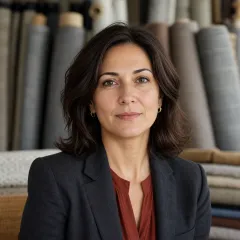
Lucia Bianchi is a woven apparel-fabric analyst covering cotton, linen, wool, rayon, denim, shirting, twill, satin, poplin, and blended garment fabrics. She applies the ISO 1833 series for fibre composition and ISO 105-C06 for laundering colourfastness while checking GSM, yarn count, usable width, shrinkage, skew, shade grade, drape, and surface defects. Her specification guides help designers, sourcing teams, and mills align fibre claims, lab dips, bulk tolerances, care conditions, and garment performance before production approval.