Material Development
Maharam Rugs, Upholstery Fabric OEM, and a Sheer Curtain Fabric Wholesale Cost Guide: A B2B Buyer’s Take
If you’re sourcing textiles for a client-facing space, start with Maharam—or another brand with the same specification-grade rigor—and treat the first swatch as the beginning of the conversation, not the end. In the six years I’ve managed purchasing for a 200-person architecture firm, we’ve placed roughly 70 textile orders a year. The projects that looked expensive without costing the most all followed one rule: the fabric decision was made on performance data first, tactile quality second, and price last. The most expensive fabric you can buy is the one that fails the burn test and has to be replaced. That’s not a metaphor. I’ve paid for it.
Why should you trust that? I’m an office administrator, not a textile scientist. I handle all our interior finishes purchasing—roughly $300,000 annually across about 12 vendors. When I took over this role in 2020, I knew nothing about rub counts, dye lots, or flame retardancy. I learned because a curtain order smoldered. Actually—I should add—it wasn’t the fabric; it was the lining. The fabric was rated FR, but the lining wasn’t. The room didn’t burn, but the panel did. And our reputation almost did too.
So here’s what I wish someone had told me when I started:
Maharam Rugs: The Hand Test
When a designer specifies a Maharam rug, they’re buying more than a floor covering. They’re buying a color statement that will survive a decade of foot traffic and a client who runs their hand over it and asks what it is. I’ve specified Maharam rugs for two client lounges and one executive dining room. Did they cost more than the alternatives? Yes. Did the client ever mention the cost? No. They mentioned the texture.
If you’re choosing a Maharam rug for a high-traffic area, ask for a larger memo sample and walk on it for a week. A desk swatch will not tell you how it handles a rolling chair. That sounds obvious, but I’ve made the mistake of trusting a swatch and then watching a chair leave tracks in a pile that looked resilient in the sample. The rug passed the hand test. It failed the wheels.
Upholstery Fabric OEM: When to Use It, When to Go Branded
Let’s be honest: “upholstery fabric OEM” is one of those terms that can mean twenty different things. It can mean a factory that weaves a private-label fabric to your spec. It can also mean a broker who adds a markup and calls it custom. I use OEM suppliers when the order is large, the spec is simple, and the end user will never sit in the chair. But for seating that guests touch—reception chairs, conference seating, lounge furniture—I’d rather specify branded upholstery through a distributor or directly.
None of this is a dig at OEM quality. A good upholstery fabric OEM can match—or exceed—a branded mill on abrasion and colorfastness. What they can’t match is the shortcut: when I order Maharam, I don’t have to explain to a client why the fabric looks premium. It already does. That’s a perception shortcut, and in front of a client, perception is part of the product.
Velvet Curtain Fabric Distributor: Vet the Dye Lots
Velvet is where I learned to be paranoid. A velvet curtain fabric distributor can show you a gorgeous stock swatch and then ship a roll that looks like a different color under window light. That happened to me in 2023. We approved a deep plum velvet based on a sample under our office lighting. The install looked brown. The distributor said the dye lot had shifted. I had no contract language for dye lot tolerance, so we ate the replacement cost: about $2,400.
Now I request a cut from the actual roll and a dye lot number before any velvet curtain fabric distributor gets a PO. If they hesitate, I move on. I don’t care how good their price is. Maharam controls dye lots tightly, which is why I specify it for velvet. That consistency is worth something in a dark corridor where every seam shows. If you work directly with a distributor, require the same consistency in writing.
A Sheer Curtain Fabric Wholesale Cost Guide That Actually Helps
I’m not going to give you a per-yard price for sheer curtain fabric wholesale, because any number I put here will be stale by the time you read it. Instead, here’s the cost guide I use when estimating a project.
First, material. Then, in roughly this order: finishing, flame treatment, edge tape, heading tape, sampling, freight, and the cost of a rejected roll. Most first-time buyers forget that a sheer curtain fabric wholesale order is not one price. It’s a stack of line items, and the line items you don’t know about are the ones that blow your budget.
- Testing. If the sheer fabric goes into a commercial space, you need FR certificates and often acoustic data. That testing is not free.
- Minimums. A distributor may offer a low per-yard price but a high minimum. If you only need 300 yards, sample yardage becomes a hidden tax.
- Lead time. Sheers are often made overseas or on custom looms. The difference between a 4-week and a 12-week lead time can change the cost of your entire schedule.
- Replacement risk. Plan for one roll to arrive with a flaw. If it doesn’t happen, great. If it does, you’re not panicking.
Here’s the counterintuitive part: the bargain sheer fabric I once ordered wasn’t a bargain. It came in about $6 per yard below the alternative, but it frayed at the edges and needed double-finishing. Then it sagged because the heading tape was specced separately. By the time we fixed both, the bargain cost more than the specification-grade option would have. I should add that the option I switched to was Maharam, and it performed better. The lesson still applies.
A quick note on sustainability claims: many sheers are now marketed as “recyclable” or “eco-friendly.” Per the FTC Green Guides (ftc.gov), those claims have to be substantiated. Why does this matter? In a B2B spec, you may be the one signing the LEED or ESG questionnaire. Ask the distributor for evidence before you believe the brochure.
What Changed My Mind
It took me four years and about 60 fabric orders to understand that “expensive” and “costly” are different words. I used to let price lead every roll order. Then I installed a budget velvet in a client’s office. The client said nothing—they just ran a hand over the armrest and frowned. We replaced it with a Maharam fabric. The same client walked into the room two weeks later, touched the chair, and asked, “Who makes this?” The rest of the meeting was easy.
There’s something satisfying about watching a client stop mid-sentence to touch a fabric. It doesn’t happen with a spec sheet. It happens when the material is right.
Looking back, I should have built sample approval and dye lot tolerance into the first velvet PO. At the time, I assumed the distributor’s responsibility ended at matching the swatch. It didn’t. Even after we switched to a premium fabric, I kept second-guessing. What if finance flagged the added cost? Four months later, the client renewed their contract. I’ll take that as the answer.
The Honest Boundary
This is not a “buy Maharam for everything” article. If you’re manufacturing a hospitality line where every dollar counts, the OEM route can be right. If you’re designing a raw concrete loft with an industrial aesthetic, a polished branded textile might not fit. And if your budget forces a choice, spend the premium on the surface people touch—the chair that holds a body, the curtain that brushes an arm—and save where they only look. That’s the line I now draw.
Granted, this approach requires more upfront effort. A spec sheet with dye lot tolerances, FR certificates, and lead time assumptions is not fun to write. But it’s a lot more fun than standing in a room with a client who has spotted a color mismatch before you do.
So, my practical answer: if a client will touch it, don’t compromise. If they will only see it from across a lobby, you have room. And if you’re not sure, order the Maharam sample first. Your design will tell you.
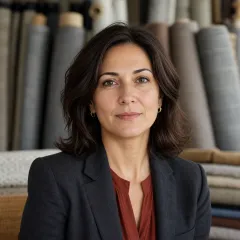
Lucia Bianchi is a woven apparel-fabric analyst covering cotton, linen, wool, rayon, denim, shirting, twill, satin, poplin, and blended garment fabrics. She applies the ISO 1833 series for fibre composition and ISO 105-C06 for laundering colourfastness while checking GSM, yarn count, usable width, shrinkage, skew, shade grade, drape, and surface defects. Her specification guides help designers, sourcing teams, and mills align fibre claims, lab dips, bulk tolerances, care conditions, and garment performance before production approval.